Best 1/2 HP Sump Pumps for Steady Basement Drainage: Top 9 Picks (October 2026)
The best 1/2 HP sump pumps include the Zoeller M98 Flow-Mate 1/2 HP Cast Iron Sump Pump for a visible power check, the Wayne CDU800 1/2 HP Cast Iron Sump Pump for a vertical float switch, and the Basement Watchdog 1/2 HP Cast Iron Sump Pump for a caged dual float.
On this page (6 sections)
The best 1/2 HP sump pump for most basements is the Zoeller M98, which combines a cast iron housing, automatic float switch and LED power plug. Wayne offers a vertical float and top suction design, while Basement Watchdog adds a caged dual float for narrow pits.
A half-horsepower rating is only one part of the choice. Check the pump’s flow at the lift your discharge needs, the pit’s inside diameter and the space available for the float to move.
For the bigger picture, start with our sump pump buying guide. If you are still comparing motor sizes, see how to determine sump pump size.
Our picks at a glance
-
1
 Best for a visible power check
Zoeller M98 Flow-Mate 1/2 HP Cast Iron Sump Pump
9.3/10 our score
See it on Amazon -
2
 Best for a vertical float switch
Wayne CDU800 1/2 HP Cast Iron Sump Pump
9.1/10 our score
See it on Amazon -
3
 Best for a caged dual float
Basement Watchdog 1/2 HP Cast Iron Sump Pump
8.0/10 our score
See it on Amazon
- 4
 Check it
LANCHEZ 1/2 HP Cast Iron Sump Pump
Best for a long power cord - 5
 Check it
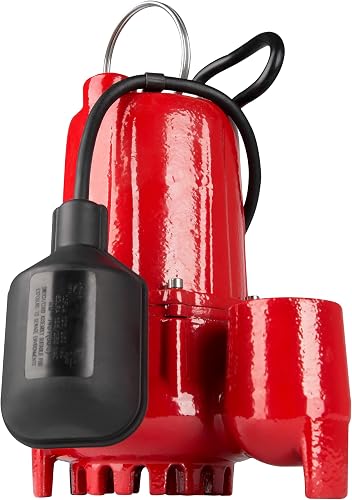
Red Lion RL-SC50T 1/2 HP Sump Pump
Best for a tethered float - 6
 Check it
Superior Pump 92572 1/2 HP Thermoplastic Sump Pump
Best for thermoplastic construction - 7
 Check it
Red Lion 1/2 HP Stainless Steel Sump Pump
Best for an 11 in pit - 8
 Best for adjustable float controlCheck it
- 9
 Best for replacing a pedestal pumpCheck it
Which 1/2 HP sump pump fits your basement?
The Zoeller M98 is the strongest all-around pick here, while the other pumps suit specific switch, pit or material needs. Compare those details with your basin and discharge setup before choosing.
Zoeller M98 Flow-Mate 1/2 HP Cast Iron Sump Pump: Best for a visible power check
- Automatic snap action float switch
- LED power plug
- Cast iron housing
- Vortex impeller
The M98 pairs a built-in automatic float with an LED plug that lets you check for power at a glance. Its vortex impeller is designed to pass solids.
Pros
- LED power indicator
- Automatic float operation
- Stainless steel hardware
Cons
- Confirm pit fit and discharge connection before buying
The Zoeller M98 is the top pick for a homeowner who wants a visible power check. Its LED plug lets you see whether the pump is receiving power, and the built-in snap action float turns the pump on and off automatically.
The cast iron housing surrounds an oil-filled motor, and the vortex impeller is designed to pass solids. Zoeller gives a maximum lift of 23 ft and says the pump can remove up to 4,320 gallons per hour.
Stainless steel hardware, a float guard and switch arm help resist rust and corrosion. Check the pit dimensions and outlet position before installation, and keep the plug visible enough to use its indicator.
Choose the M98 when the LED plug and automatic operation are useful in your setup. Its combination of switch, construction and power indicator makes it the clearest fit for most standard residential pits.
Wayne CDU800 1/2 HP Cast Iron Sump Pump: Best for a vertical float switch
- Vertical float switch
- Top suction design
- Cast iron and corrosion-resistant steel
- 3-year warranty
Wayne combines a vertical float switch with a top suction design that minimizes clogging and avoids the need for a weep hole. The maker says the switch was tested to 1 million cycles.
Pros
- Vertical float switch
- Top suction design
- 3-year warranty
Cons
- Check pit diameter and discharge connection
Wayne’s CDU800 is a good fit when you prefer a vertical float switch and want a top suction design. Wayne says the switch was tested to 1 million cycles, and the top suction layout is designed to minimize clogging and avoid a weep hole.
The pump uses cast iron and corrosion-resistant steel, with a 1-1/2 in NPT discharge. Wayne gives a maximum capacity of 5,100 gallons per hour and a 20 ft maximum lift.
The stated 3-year warranty is a useful point of comparison for buyers who plan to keep a pump in service for years. Confirm that the basin and discharge line match your installation before choosing it.
Basement Watchdog 1/2 HP Cast Iron Sump Pump: Best for a caged dual float
- Caged dual float switch
- Compact size for narrow pits
- Cast iron housing
- 4,400 GPH at 0 ft lift
Two floats sit inside a protective cage that helps keep debris or wires from interfering with switch movement. Its compact design typically fits narrow sump pits.
Pros
- Two-float design
- Protective switch cage
- Compact pump size
Cons
- Flow is lower at greater lift
Basement Watchdog stands out for its caged dual float. The cage helps keep debris and wires from interfering with the floats, and the dual arrangement provides two float points in the switch system.
Its compact dimensions are 6.25 x 6.25 x 11.75 in, which can help in a narrow pit. The pump moves up to 4,400 gallons per hour at 0 ft lift and 3,540 gallons per hour at 10 ft lift, so compare the second figure if your discharge rises above the pump.
The pump has a cast iron body and a copper-wound PSC motor. It suits a buyer who values a guarded float assembly and needs to account for reduced flow as lift increases.
LANCHEZ 1/2 HP Cast Iron Sump Pump: Best for a long power cord
- Integrated vertical float switch
- 10 ft grounded power cord
- Cast iron and stainless steel casing
- 3-year technical support
The 10 ft grounded cord can help when the outlet is farther from the basin. The integrated vertical float switches on at 10.24 in and off at 4.33 in.
Pros
- 10 ft power cord
- Integrated float
- Thermal overload protection
Cons
- Measure basin and outlet placement first
LANCHEZ combines a 10 ft grounded cord with an integrated vertical float. The float’s stated on and off points are 10.24 in and 4.33 in, so check that those levels suit your basin and the water depth you want to maintain.
Its casing uses cast iron and stainless steel, and the pump includes thermal overload protection. LANCHEZ gives a maximum lift of 26 ft and says it can move up to 5,200 gallons per hour.
The brand describes the pump for basement, basin and sewage applications. For a typical sump pit, focus on its float range, cord reach and discharge fit, then confirm the pump is appropriate for the water you need to move.
Red Lion RL-SC50T 1/2 HP Sump Pump: Best for a tethered float
- Piggy-back tethered float switch
- Cast iron housing
- Passes semi-solids up to 3/8 in
- 10 ft power cord
The tethered switch can be unplugged from the pump for maintenance or testing. Red Lion gives on and off points of 13 in and 5 in.
Pros
- Switch can be bypassed for manual operation
- 10 ft cord
- 3-year manufacturer warranty
Cons
- Suitable basins are 18 in or greater
The Red Lion RL-SC50T is the choice for a tethered float switch that can be unplugged from the pump for maintenance or testing. Its piggy-back switch activates at 13 in and shuts off at 5 in, so the pit needs room for the tether to move freely.
Red Lion gives a maximum flow of 4,300 gallons per hour at 0 ft lift and a 28 ft shutoff. The cast iron housing and clog-resistant impeller are designed to pass semi-solids up to 3/8 in.
This model is intended for basins 18 in or greater, which makes pit measurement especially important. Choose it when that diameter works and you want a switch that can be bypassed for manual operation.
Superior Pump 92572 1/2 HP Thermoplastic Sump Pump: Best for thermoplastic construction
- Thermoplastic construction
- Vertical float switch
- 10 ft cord
- 1-1/2 in NPT discharge
This thermoplastic pump has automatic vertical float operation and a 10 ft cord. Superior Pump states it can lift water up to 25 ft.
Pros
- Vertical float operation
- 10 ft cord
- 3-year limited warranty
Cons
- Confirm lift and flow needs for your pit
Superior Pump’s 92572 is the thermoplastic option in this group. Its vertical float switch controls automatic operation, and the 10 ft cord gives some flexibility for outlet placement.
Superior Pump says the unit moves up to 3,300 gallons per hour and can lift water up to 25 ft. It has a 1-1/2 in NPT discharge and a 3-year limited warranty.
Pick it when you want thermoplastic construction and a straightforward vertical switch. Compare the pump’s flow and lift with your actual discharge conditions before treating the maximum figures as your expected output.
Red Lion 1/2 HP Stainless Steel Sump Pump: Best for an 11 in pit
- Stainless steel and cast iron construction
- Piggy-back vertical float switch
- Passes 3/4 in semi-solids
- 10 ft cord
Red Lion describes this model for narrow pits 11 in or wider. Its piggy-back switch can be changed to manual mode for testing or emergency water removal.
Pros
- Narrow pit fit from 11 in
- Passes 3/4 in semi-solids
- 5-year warranty
Cons
- Check available lift against your setup
This Red Lion model suits narrow pits 11 in or wider, according to the brand’s stated fit guidance. The piggy-back vertical float can be switched to manual mode for testing or emergency water removal.
Its stainless steel and cast iron construction is designed to pass 3/4 in semi-solids. Red Lion gives a maximum flow of 3,450 gallons per hour and on and off points of 7.5 in and 4.5 in.
That switch range is distinct from the tethered RL-SC50T, and the narrower pit fit may be easier to manage where space is limited. Check the pit diameter and discharge height before selecting it.
AQUASTRONG 1/2 HP Sump Pump: Best for adjustable float control
- Adjustable float switch
- Piggy-back plug
- 20 ft power cable
- Top suction design
The adjustable float and piggy-back plug allow automatic operation based on basin water level. Its top suction design is intended to reduce airlock and clogging from debris near the pit bottom.
Pros
- 20 ft power cable
- Adjustable float
- Thermal overload protection
Cons
- Recommended basin diameter is 18 in or larger
AQUASTRONG gives you an adjustable float switch and a 20 ft power cable. The piggy-back plug supports automatic operation, while the float cable lock lets you adjust switch length to suit the basin.
The pump has a top suction design intended to reduce airlock and clogging from debris near the pit bottom. AQUASTRONG gives a maximum lift of 25 ft and recommends installation in basins 18 in or larger.
Its construction combines stainless steel, thermoplastic and a cast iron volute. Choose it if the longer cable and adjustable float solve real setup needs, and confirm the basin size before buying.
Flotec 1/2 HP Sump Pump: Best for replacing a pedestal pump
- Thermoplastic body
- Comes fully assembled
- Can replace pedestal or submersible pumps
Flotec is described as a fully assembled replacement for pedestal or submersible pump types. Check the 39 in height and switch arrangement against your basin before choosing it.
Pros
- Fully assembled
- Thermoplastic body
- Can replace pedestal or submersible pumps
Cons
- Confirm operating details and pit fit before buying
Flotec is a more unusual option for a replacement pump setup because it is described as a fully assembled unit that can replace a pedestal or submersible pump. Its thermoplastic body and 39 in height make it important to confirm the full installation arrangement before choosing it.
The available details identify it as a 1/2 HP sump pump, but do not give flow, lift or float switch information. If those points determine whether it will work in your pit, confirm them with the seller before ordering.
What should you compare before buying a 1/2 HP sump pump?
Compare lift, flow, switch clearance and discharge size before deciding which 1/2 HP pump fits. A maximum flow figure at zero lift can be very different from the water delivered through a real discharge line.
Start by measuring the pit’s inside diameter and checking the space around the float. A vertical switch may suit a tight pit, while tethered switches need enough open area to move without hitting walls, pipes or cords.
Next, estimate the vertical rise from the pump to the discharge outlet. The Basement Watchdog provides separate flow figures at 0 ft and 10 ft lift, a helpful reminder that capacity falls as water rises.
Check the discharge connection, too. Several picks use a 1-1/2 in connection, but confirm your existing pipe size and local installation requirements before assuming a direct fit.
For homeowners comparing iron and plastic bodies, our cast iron vs plastic sump pump guide covers the material tradeoffs. If the basin itself is limiting your options, see how deep a sump pit should be.
Which float switch style works in a sump pit?
A float switch works best when it can move through its full on and off range without obstruction. Match the switch style to the pit width, pump position and nearby discharge pipe.
A vertical float moves along a vertical path and can be easier to place in a compact basin. Wayne, Superior Pump and the Red Lion stainless model use vertical float arrangements.
A tethered float swings outward as water rises. It needs free space, so check that the tether will not catch on the pump, pit wall or wiring.
The Red Lion RL-SC50T uses this style.
A caged dual float puts the switch floats inside a protective cage. Basement Watchdog’s design is worth considering if debris or wiring could interfere with a freely moving float.
If you are choosing between tethered and vertical designs, read our sump pump float switch comparison. Test the finished installation by adding water to the basin and confirming that the pump starts and stops at the intended levels.
Is cast iron the right housing for your pump?
Cast iron is a common choice in this roundup, but housing material should not be the only deciding factor. Consider the pit conditions, water being moved, switch layout and service access together.
Zoeller, Wayne, Basement Watchdog and Red Lion use cast iron in their listed construction details. LANCHEZ combines cast iron with stainless steel, while AQUASTRONG combines stainless steel, thermoplastic and a cast iron volute.
Superior Pump and Flotec use thermoplastic bodies. A lighter material may appeal if weight matters during handling, but all pumps still need the right flow, lift and installation fit for the job.
For a closer look at cast iron models, see our roundup of best cast iron sump pumps. If you want to understand the pump’s cycle and discharge path first, our guide explains how a sump pump works.
How often should you test a new sump pump?
Test a sump pump after installation and check it before the wet season. Pour water into the basin until the float activates, then confirm the pump starts, discharges water and shuts off when the level drops.
Check that the discharge flows away from the foundation and that the check valve prevents water from returning to the pit. Listen for unusual sounds and make sure the float can move without obstruction.
A backup pump or alarm can add another layer of warning if power fails or the primary pump cannot keep up. See our guides to battery backup sump pumps and sump pump alarms when planning those additions.
Which 1/2 HP sump pump should you choose?
Choose the Zoeller M98 if you want a cast iron pump with an automatic float and a visible LED power plug. Pick Wayne for its vertical float and top suction layout, or Basement Watchdog when a caged dual float and compact body fit your pit.
Use the Red Lion RL-SC50T only if your basin has enough room for its tethered float and meets its 18 in fit guidance. For another motor-size comparison, read 1/3 or 1/2 HP sump pump: which size do you need?.
Our top 3 picks at a glance
-
1
Best for a visible power check
Zoeller M98 Flow-Mate 1/2 HP Cast Iron Sump Pump
9.3/10 our score
See it on Amazon -
2
Best for a vertical float switch
Wayne CDU800 1/2 HP Cast Iron Sump Pump
9.1/10 our score
See it on Amazon -
3
Best for a caged dual float
Basement Watchdog 1/2 HP Cast Iron Sump Pump
8.0/10 our score
See it on Amazon
Frequently asked questions
Is a 1/2 HP sump pump enough for a basement?
A 1/2 HP pump can suit a basement when its flow and lift match the water entering your pit and the height of your discharge. Compare those needs with the pump’s performance details, then check the basin size and discharge connection.
Horsepower alone does not show how much water a pump moves at your actual lift.
What is the best float switch for a 1/2 HP sump pump?
The best switch depends on your pit shape and how much room the float can move. A vertical float can work in a compact pit, while tethered floats need room to swing.
Caged dual floats add a guard around the switch.
Measure the pit and check where pipes or wires could interfere.
Does a 1/2 HP sump pump need a check valve?
A check valve helps keep discharge water from flowing back into the sump pit after the pump stops. Match the valve to the discharge pipe and install it in the position recommended for your setup.
See our guide to sump pump check valve location before planning the discharge line.
How do I choose between 1/3 HP and 1/2 HP?
Choose based on the water load, discharge height and pipe setup, not horsepower alone. A 1/2 HP model may suit higher water demands, but its flow changes with lift and system conditions.
Our guide to 1/3 or 1/2 HP sump pumps walks through the sizing choice.


