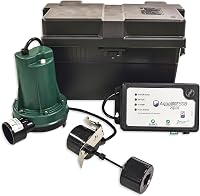
What Type of Battery for a Sump Pump Backup?
A sealed AGM (absorbent glass mat) battery is the right type for most sump pump backups. It needs no water top-ups, won't spill if tipped, and comes in 12V sizes that fit common backup pumps. Pick a flooded battery only if your charger is built for one.
On this page (9 sections)
- What type of battery for sump pump backup works best?
- Why AGM beats flooded and gel for most basements
- How voltage and capacity decide the type you need
- Matching the battery to your pump brand
- The battery types you should avoid in a sump pit
- Sealed versus maintenance free: what the labels mean
- How long a backup battery lasts and when to replace it
- Wiring, charging and safe placement
- A simple way to pick your battery type today
A 12V sealed AGM battery is what you want for almost any sump pump backup. It holds its charge on a shelf, needs no water, and won't leak acid onto your basement floor.
Getting the chemistry right matters as much as the amp-hour rating, so this guide walks through the main types, what each one suits, and how to match a battery to your pump.
Most basement owners focus on size, then forget that two batteries of the same amp-hour rating can behave very differently. Chemistry decides how the battery charges, how fast it recovers, and how long it lasts in standby.
Here is how the options compare.
What type of battery for sump pump backup works best?
AGM (absorbent glass mat) is the best all-round type for a sump pump backup. It is a sealed lead acid battery with the electrolyte held in glass mats, so it can be shipped charged, mounted in any position, and never needs topping up.
Three families dominate the shelf:
- AGM: sealed, maintenance free, good at delivering high current quickly. This is the common pick for sump pumps.
- Gel: also sealed, but the acid is mixed into a paste. Slower to charge, and best left to deep cycle uses like trolling motors.
- Flooded wet cell: the traditional open battery with removable caps and liquid acid. Cheap and proven, but it vents hydrogen, can spill, and demands regular water checks.
For a backup pump that sits idle for months and then has to run hard during a storm, AGM's low self-discharge and fast recharge fit the job. A flooded cell can work, but only if the charger is set for it and you accept the upkeep.
The pump side matters too. A battery is only half of a system, and the pump, float and alarm all have to keep working while power is out.
A deep cycle battery paired with a tested pump is the combination that actually protects the floor.
If you are still deciding whether a backup system makes sense for your home, our guide on is a battery backup sump pump worth it covers the math.
Pick AGM unless your system's charger or manual clearly calls for another type.
Why AGM beats flooded and gel for most basements
AGM is the safest and lowest-effort choice in a damp basement. Flooded batteries can spill acid if knocked over, and they release gas while charging, so they need ventilation.
AGM greatly limits venting but does not fully eliminate it, so airflow is still advised.
The glass mat soaks up the acid so the battery can sit sideways without leaking. That matters in a tight pit or a crowded utility corner where a wet cell would be risky.
AGM also holds a charge on the shelf longer, which suits a battery that waits for an emergency.
Gel batteries are sealed too, but they charge more slowly and don't like the high inrush current a pump demands at startup. They suit slow, deep draws, not the on-off bursts of a sump cycle.
Flooded batteries still have fans. They are cheap, easy to find, and many older systems were built around them.
But the water checks get skipped, and a dry cell fails when you need it most.
AGM's sealed design is why it has become the default for standby duty. PumpSpy says its AGM battery doesn't sulfate or degrade the way wet cells can, because the electrolyte is locked in the glass mats instead of freely flooding the plates.
The same battery is built so it can be used in any orientation, so a tight pit does not force a specific mounting angle.
Go AGM for a basement you don't want to babysit; keep flooded only if the charger is built for it.
How voltage and capacity decide the type you need
Match the voltage your pump expects, then size the amp-hour rating to your run time. Almost every home backup pump runs on 12V.
A few large systems use 24V by pairing two batteries in series.
Capacity is the other half. A 75Ah battery holds more energy than a 40Ah one, so it runs the pump longer before the charge drops.
The pump's chart usually lists run times for different amp-hour ratings, so check that before you buy.
Bigger isn't always better. A battery far larger than the charger can refill will sit undercharged, which shortens its life.
Match the amp-hour rating to what the charger was designed to top up.
Normal flooded cells are often rated in reserve minutes rather than amp hours, which makes comparison harder. AGM batteries are usually sold in amp hours, so you can line them up against the pump chart directly.
Our guide on what size battery for sump pump backup works through the run-time math for common pump models.
Reading the run-time numbers
The Basement Watchdog BW-27AGM shows how run time is quoted. It's rated for up to 40 hours on the Big Dog, up to 48 hours on the Special + and Big Combination systems, and up to 80 hours on the Emergency and Combination systems.
Every one of those figures is based on a 10% duty cycle.
That means the pump runs for one tenth of the time, which is a light load and not a steady flood. A real storm may push the pump harder, so treat those hours as a comparison tool between batteries, not a promise for a wet night.
Basement Watchdog says the battery runs various Basement Watchdog systems intermittently for days. That wording is the honest one: intermittent running, not continuous pumping.
Use it to see how one battery stacks up against another on the same pump, and do not use it to plan a long outage with a heavy inflow.
Choose the voltage first, then pick the amp-hour rating the charger can maintain.
Matching the battery to your pump brand
A matched battery is the safest choice because the charger settings are known to fit. Several pump makers sell batteries built for their own backup systems, and those pairings remove a lot of guesswork.
Wayne builds the WSB1275 for its ESP25N, WSS30VN, WBPS50 and other Wayne backup systems. It is a 12V/75Ah sealed battery, so it drops into those kits without a compatibility question.
It comes fully charged with carry handles, which makes the swap easier than hauling a wet cell out of a pit.
Basement Watchdog sells the BW-27AGM for its own line. The maker lists run times for its Big Dog, Special +, Big Combination, Emergency and Combination systems, ranging from about 40 to 80 hours at a 10% duty cycle.
Older Basement Watchdog units built before 2014 with a Remote Terminal are compatible with the maintenance free battery. The maker's own note says those older versions of the Special, Big Dog and Big Combo are compatible only if they include the Remote Terminal.
If your system is older and lacks it, the maintenance free battery may cause false alarms rather than help.
Buying a generic AGM battery works too, as long as voltage and amp-hour rating meet the pump's chart. The risk is a charger built for flooded cells that undercharges a sealed battery.
Match the battery to the maker's list when one exists; otherwise confirm charger compatibility.
The battery types you should avoid in a sump pit
Car starting batteries and ordinary marine cranking batteries are the wrong type. They are built for a short burst of high current, then an immediate recharge from an alternator, not for sitting at partial charge for months.
A starting battery has thin plates that shed material under deep discharge. Run one down a few times in a storm and it may not hold a charge again.
A deep cycle AGM or marine battery is built to be drawn down and recharged repeatedly.
Cheap maintenance free car batteries also tend to have low amp-hour ratings. A 40Ah cranking battery won't run a sump pump through a long outage the way a 75Ah deep cycle will.
Lithium is a different case. A lithium battery packs more usable energy into less weight, but the charger has to be set for lithium.
Most home backup kits ship with a lead acid charger, so a lithium swap risks overcharging or an incomplete charge.
If a battery has been sitting in a garage for years, its capacity is likely well below the label. Check the date code before trusting it in an emergency.
A bad match can also show up as a false alarm. Basement Watchdog warns that an old non-compatible system may read a maintenance free battery as a problem when nothing is wrong.
That is a chemistry mismatch, not a dead battery, and it wastes time during a storm.
Avoid starting batteries and unmatched lithium; choose a deep cycle lead acid built for standby.
Sealed versus maintenance free: what the labels mean
Maintenance free means you never add water; sealed means it won't leak. Most AGM batteries are both, but the labels aren't interchangeable across every product.
A flooded battery can be sold as maintenance free if it has enough acid reserve to last its service life without topping up. It still vents gas and can still spill if tipped.
The caps are usually sealed shut, so you can't check the electrolyte.
A sealed AGM battery holds the acid in glass mats with no free liquid. You can mount it on its side, and a tip-over won't dump acid on the floor.
That is a real advantage in a crowded pit.
Maintenance free is the feature that saves you weekends. No distilled water, no hydrometer, no acid burns.
You install the battery, connect the charger, and test it now and then.
Some makers use "maintenance free" loosely, so read whether the battery is AGM or flooded before you assume it is sealed. The chemistry line on the case tells you.
PumpSpy says its AGM battery avoids spilled acid from a tipped battery and hydrogen gas venting because the case is completely sealed. It also says the thermally welded enclosure eliminates leakage.
Whether or not you buy that brand, those are the properties to look for on any label.
Treat "sealed AGM" as the gold standard and "maintenance free flooded" as a cheaper compromise.
How long a backup battery lasts and when to replace it
Most sealed backup batteries give several years of standby service. Actual life depends on how often the charger cycles them, the basement temperature, and how many outages the pump has handled.
A battery kept on a smart charger and only drained during storms tends to last longer than one that sits discharged. Heat is the quiet killer.
A battery near a furnace or in a hot garage ages faster than one in a cool corner.
Test the battery with the pump's test button every few months. If the pump runs weakly or the alarm chirps soon after a full charge, the battery is near the end.
Don't wait for a storm to find out.
Our guide on how long do battery backup sump pumps last covers the pump side of that lifespan, and the battery usually goes first.
Replace with the same chemistry and amp-hour rating, or a step up if the charger can handle it. Mixing an old flooded charger with a new AGM battery can shorten the new battery's life.
Plan to replace the battery every few years, and test it before each storm season.
Wiring, charging and safe placement
Keep the battery upright, ventilated and on a charger rated for its chemistry. Even sealed batteries vent a little gas under charge, so the spot needs some airflow.
Mount the battery close to the pump so the cables reach without strain. Keep terminals clean and tight, and coat them with a little dielectric grease to slow corrosion.
A loose terminal can cause a voltage drop that looks like a weak battery.
The charger should match the battery's voltage and chemistry. Most backup kits include a charger, so this is handled.
If you add a second battery or swap chemistry, confirm the charger's settings first.
Never charge a frozen battery, and don't charge one with a bulging case. Both are signs the cell is damaged and could fail dangerously.
A battery box adds protection from bumps and keeps terminals covered. It also stops a dropped tool from bridging the posts and sparking.
Check the weight before you plan the swap. A large AGM battery can be heavy, so a two-person lift or a helper with a strap is safer than carrying it down a flight of stairs alone.
Carrying handles make the job easier on the Wayne sealed battery.
Charge with the right charger, keep terminals clean, and replace any battery with a swollen case.
A simple way to pick your battery type today
Start with AGM at 12V, sized to your pump's chart. That single rule covers most basement setups, and the matched-brand batteries remove the last bit of doubt.
If you own a Wayne system, the WSB1275 is the direct fit. If you run Basement Watchdog, the BW-27AGM carries listed run times for the line.
If you have a generic or mixed setup, a 75Ah AGM like the PumpSpy unit meets most pump charts.
Check the model year on older systems before changing chemistry, especially Basement Watchdog units from before 2014. And if you are buying a pump and battery together, our roundup of the best battery backup sump pump options pairs them for you.
The short version: sealed AGM, 12V, amp-hour rating matched to the charger, deep cycle rather than starting. That answer holds whether you are replacing a dead battery or setting up a new system.
Write the model number of your pump on the battery's label when you install it. That one note saves you when the next battery swap comes around, and it makes any warranty call easier.
A few seconds now buys a clean answer later.
Pick AGM for most basements; pick a matched brand battery if the maker sells one; never use a car starting battery.
Frequently asked questions
How long will a backup sump pump battery last?
Most sealed backup batteries are built for several years of standby use. Real service life depends on how often the charger cycles them and how often the pump actually runs.
Replace yours when the pump's test mode shows weak runtime.
Should I use a car battery for a sump pump backup?
A car battery is not the right choice. Starting batteries are built for short bursts of high current, not the slow, repeated drain of a sump pump.
Use a deep cycle marine or AGM battery rated for standby duty instead.
Can I use a lithium battery for a sump pump backup?
Lithium batteries can power a backup pump, but the charger has to be built for lithium chemistry. Most home backup systems ship with a charger set for lead acid.
Unless the maker lists lithium support, stay with AGM or sealed lead acid.
Does the battery brand need to match the pump brand?
No, but a matched battery is the safest fit. Several makers, including Wayne and Basement Watchdog, build or recommend batteries for their own systems.
A generic AGM battery will work if its voltage and amp-hour rating meet the pump's chart.
What is the difference between AGM and gel batteries?
Both are sealed, but they hold the acid differently. AGM uses glass mats; gel mixes the acid into a paste.
AGM handles higher discharge currents and charges faster, which makes it the better match for a sump pump that pulls power quickly.
Do backup sump pump batteries need a special charger?
Yes. The battery needs a charger matched to its chemistry and voltage.
Most backup pumps come as a kit with a charger built in.
If you buy a battery separately, confirm the charger's settings suit AGM or flooded cells.