9 Best Automatic Sump Pumps for Basements (November 2026)
The best automatic sump pumps for basements include the AQUASTRONG 1 HP Sump Pump 4500 GPH for high water volume, the LANCHEZ Sump Pump for big, debris-heavy water, and the Zoeller M53 Mighty-Mate 1/3 HP Sump Pump for average basement pits.
On this page (7 sections)
The best automatic sump pump for most basements is the Zoeller M53, a cast iron pump with a float switch for average pits. For high water volume, the AQUASTRONG 1 HP moves serious water fast.
The Wayne CDU980E suits homes that flood in every heavy storm.
Automatic means the pump starts without you standing over it. A float or sensor detects rising water, the motor kicks in, and the water leaves through the discharge pipe.
That matters most during a storm at 2 a.m., when nobody is watching the pit.
This guide compares 9 automatic pumps by motor size, flow rate, switch type and the kind of water each one handles. Our score weighs specs, features and buyer feedback against what you're shopping for.
Our picks at a glance
-
1
-
2

-
3
 Best for average basement pits
Zoeller M53 Mighty-Mate 1/3 HP Sump Pump
9.2/10 our score
See it on Amazon
- 4
 Check it
Wayne CDU980E 3/4 HP Cast Iron Sump Pump
Best for heavy storm seasons - 5
 Best for quick replacement installsCheck it
- 6
 Check it
Cleartide 1/3 HP Submersible Utility Pump
Best for shallow flooded floors - 7
 Check it
Green Expert 1/3HP Submersible Sump Pump Kit
Best all-in-one drainage kit - 8
 Check it
Acquaer 1/3 HP Automatic Sump Pump
Best for budget floor drainage - 9
 Check it
Green Expert 1/3 HP Sump Pump with Water Sensor
Best for the last inch of water
The best automatic sump pumps for basements
The AQUASTRONG is the high-flow pick, but the other picks win for average pits, narrow spaces, shallow floors and tight budgets. Match the pump to your pit and your water before you match it to a price tier.
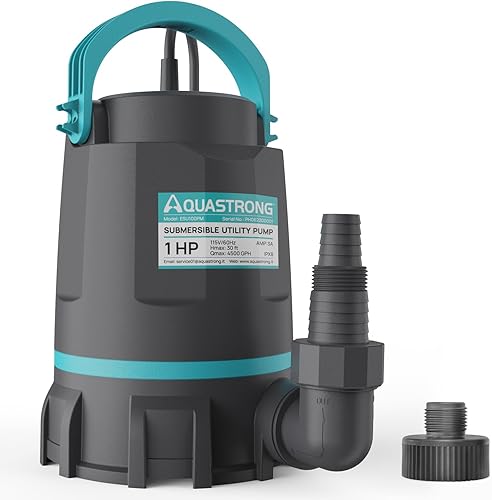
AQUASTRONG 1 HP Sump Pump 4500 GPH: Best for high water volume
- 1 HP motor
- 4500 GPH at 5 ft
- Lifts water 30 ft
- Built-in thermal overload protector
A high-flow submersible pump for basements that take on a lot of water quickly. It moves up to 75 gallons a minute and handles small solids.
Pros
- Strong 4500 GPH flow at 5 ft
- Handles solids up to 1/5 in
- Thermal overload protection
Cons
- More pump than a small, dry pit needs
- Needs a power source rated for a 1 HP motor
The AQUASTRONG suits a basement that fills fast, where a standard pump can't keep up. Its 1 HP motor moves up to 4500 GPH at 5 ft of lift, which is about 75 gallons a minute.
The 30 ft maximum lift pushes water up a tall discharge run.
The bottom suction design pulls water down to about 1/5 in and passes solids up to 1/5 in, so grit and small debris don't jam it. A thermal overload protector shuts the motor down if it runs dry.
Note that this is a manual utility pump: you plug it in to run and unplug it to stop. It has no float or sensor, so it does not start itself.
For hands-off basement protection, pair it with an automatic pump or choose one of the float or sensor picks below.
Installation is friendly for a big pump. It comes with a 1-1/4 in NPT discharge and adapters for 3/4 in, 1 in and 1-1/4 in fittings, plus a 10 ft UL power cord.
The reinforced thermoplastic casing resists corrosion and abrasion, and a mechanical seal guards against leaks. At 8.5 lb it is lighter than the cast iron pumps here, so one person can lower it into a pit without strain.
The turquoise body is easy to spot in a dark basin.
The trade-off is size and power. A 1 HP motor draws more current than the 1/3 HP picks, and a small, dry pit gains nothing from the extra flow.
Buy it when water volume is the real problem and you can attend to it.
LANCHEZ Sump Pump: Best for big, debris-heavy water
- 1.6 HP motor
- 6000 GPH max flow
- Float switch turns on at 5.3 in
- Stainless steel body
A powerful stainless steel pump for flooded pits and dirty water. The float switch makes it automatic, and the high baseplate passes larger particles.
Pros
- Highest flow in this group
- Passes particles up to 4/5 in
- IPX8 waterproof rating
Cons
- High baseplate needs deeper standing water to start
- Large pump for a narrow pit
LANCHEZ is the pick when the water is dirty or the pit is deeper than a standard basin. The 1.6 HP motor is the largest here, with a max flow of 6000 GPH and a 30 ft head.
The float switch makes it automatic, starting at a minimum water level of about 5.3 in. Keep the switch upright for manual control when the water is low.
A thermal overload protector guards the motor during long runs.
Stainless steel and an IPX8 rating make it a candidate for wet, messy spaces. The high baseplate passes particles up to 4/5 in, so leaves and grit clear the impeller.
The bottom impeller is PA66 for added resilience, and a mechanical seal prevents leaks.
The setup has a 1-1/2 in NPT discharge with a garden hose adapter, an elbow and a multi-hose adapter, plus a 16 ft cord. It suits sump basins, flooded basements and pits with debris.
A top handle makes it easier to carry to the pit.
The catch is the high baseplate: it needs more standing water to start than a low-suction sensor pump. For a shallow floor puddle, a sensor pump drains lower.
The maker also warns against running it above 95°F, since hot water can wear the seal and bearings. A 1.6 HP motor in a tight pit can also feel oversized.
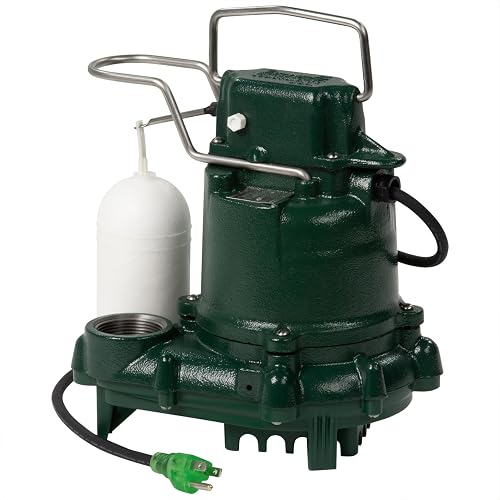
Zoeller M53 Mighty-Mate 1/3 HP Sump Pump: Best for average basement pits
- 1/3 HP motor
- Float-activated automatic switch
- Cast iron motor and pump housing
- Non-clogging vortex impeller
A cast iron automatic pump built for everyday sump duty. The vortex impeller handles small solids, and the float switch turns it on without setup.
Pros
- Cast iron housing and switch case
- Vortex impeller resists clogs
- LED power plug shows power at a glance
Cons
- Lower lifting height than the big pumps here
- Cast iron makes it heavier to lift into the pit
The Zoeller M53 is the everyday answer for a standard basement pit. Its cast iron motor and pump housing give it heft and heat resistance, and the float-activated switch turns it on automatically with no wiring.
The vortex impeller is the quiet star. It handles small solids without clogging, which keeps the pump running when grit reaches the pit.
Hardware, the float guard and switch arm are stainless steel.
An LED power plug lets you check for power at a glance, a small feature that saves a lot of guessing during a storm. The epoxy-coated finish resists wear, and Zoeller factory-tests each pump in water before shipping.
The motor is oil-filled for cooling, which helps it run quietly and last longer in steady duty. It measures about 10 by 8 by 10 in, so it drops into a typical basin.
Its 19.25 ft maximum lift is lower than the big pumps here, so it suits a basement that drains to a shallow outlet rather than a tall vertical run. At 21 lb, it also takes more effort to lower into the pit.
The plastic base is the one part that isn't cast iron. Buy it for dependable automatic duty in an average pit, not for a flood that overwhelms a 1/3 HP motor.
For lighter loads, our guide to 1/3 hp sump pumps covers the smaller options.
Wayne CDU980E 3/4 HP Cast Iron Sump Pump: Best for heavy storm seasons
- 3/4 HP motor
- 5490 GPH
- Integrated vertical float switch
- Cast iron and stainless steel body
A high-capacity pump for storm-heavy basements. The vertical float fits narrow pits, and the top suction design reduces air lock and clogging.
Pros
- Pumps up to 5490 GPH
- Vertical float suits narrow sump pits
- Top suction design reduces air lock
Cons
- Needs an 11 in or larger sump pit
- High flow draws more power than a 1/3 HP pump
Wayne's CDU980E is the storm-season pick. The 3/4 HP motor pumps up to 5490 GPH, a step above the 1/3 HP pumps and close to the AQUASTRONG's output.
The rated flow works out to about 92 gallons a minute, so it clears a rising pit quickly.
Its integrated vertical float switch fits narrow sump pits, where a wide tethered float would hang up on the wall. The top suction design pulls water from above the base, which reduces air lock and clogging.
It also installs without a weep hole.
The body is cast iron and stainless steel, and Wayne assembles it in the USA with a 5-year warranty. A carry handle makes it easier to lift into place.
At 12 lb it is lighter than the cast iron Zoeller, so the install is less of a wrestle.
This is a pump for heavy rain, snow melt and steady groundwater. It needs an 11 in or larger sump pit, so measure yours first.
The vertical float also gives you less control over the start level than a sensor pump. It is rated for indoor use only, so it belongs inside the basement, not in an outdoor pit.
Wayne CDU790 1/3 HP Sump Pump: Best for quick replacement installs
- 1/3 HP motor
- 4600 GPH
- Integrated vertical float switch
- Top suction design
A 1/3 HP automatic pump that installs in about 15 minutes with no weep hole. The tested float switch and top suction design keep it working in a standard pit.
Pros
- Installs without drilling a weep hole
- Float switch tested to 1 million cycles
- Epoxy-coated steel resists corrosion
Cons
- Needs an 11 in or larger sump pit
- Lighter build than the cast iron picks here
The Wayne CDU790 is the replacement pump for a standard 11 in pit when you want the job done in one afternoon. Wayne says it installs in about 15 minutes with no plumbing changes and no weep hole to drill.
The 1/3 HP motor pumps up to 4600 GPH at zero feet, so it covers normal basement water without the current draw of a bigger motor. The integrated vertical float switch is tested to 1 million cycles, and the top suction design filters debris.
The rated flow is about 63 gallons a minute, and it lifts water up to 20 ft.
An epoxy-coated steel housing and cast iron volute give it long life, and the float guard keeps the switch from hanging up. The 1-1/2 in NPT discharge fits common pipe sizes.
A ceramic mechanical seal adds to the service life, and an easy-carry handle helps with lifting.
Compared with the M53, it is lighter (16.4 lb) and easier to handle, but its steel housing gives up some of the cast iron heft. Choose it for a quick swap in a standard pit; choose cast iron if you want maximum motor housing durability.
It also needs an 11 in or larger pit and is for indoor use. Our roundup of cast iron sump pumps compares those builds directly.
Cleartide 1/3 HP Submersible Utility Pump: Best for shallow flooded floors
- 1/3 HP motor
- 2790 GPH
- Water sensor starts at 1-1/5 in, stops at 1/5 in
- Auto and manual modes
A sensor-controlled pump for water that spreads across a floor rather than sitting in a pit. It starts at about 1-1/5 in and stops near 1/5 in.
Pros
- Drains down to about 1/5 in
- Auto and manual modes
- Dry-run protection shuts it off in seconds
Cons
- Lower flow than the pit pumps here
- Handles solids only up to 1/8 in
The Cleartide is not a pit pump, and that's its strength. It uses a water sensor instead of a float, starting at about 1-1/5 in and stopping near 1/5 in, so it clears water that spreads across a basement floor.
The 1/3 HP motor moves 2790 GPH and lifts water 30 ft. It has an auto mode for hands-off draining and a manual mode for ponds and garden jobs.
A 100% copper-wound motor runs cooler. At about 8.4 lb it is easy to carry from a flooded window well to a hot tub.
Three protections matter here: it shuts off in seconds when running dry, stops when tipped, and clears air locks on its own. It passes solids up to 1/8 in.
A 10 ft cord plus a 1-1/4 in NPT elbow and dual adapters let it connect to a garden hose out of the box.
Compared with the pit pumps, its flow is lower and it won't sit in a deep basin. The auto sensor also means it can't be told to start at a deeper level the way a float can.
For a flooded window well, a wet garage floor or a hot tub, though, it drains lower than any float pump here.
Green Expert 1/3HP Submersible Sump Pump Kit: Best all-in-one drainage kit
- 1/3 HP motor
- 2000 GPH
- 25 ft lay-flat discharge hose included
- 3 sensor positions for start level
A pump and hose sold as one kit, ready to drain a flooded floor. The water sensor offers three start positions and a manual mode for shallow water.
Pros
- Comes with a 25 ft lay-flat hose
- Drains to 1/25 in in manual mode
- Three sensor start positions
Cons
- Lowest flow of the higher-scored picks
- Hose and pump only suit clean or slightly dirty water
The Green Expert kit is for the reader who wants one box and no extra shopping. It pairs a 1/3 HP pump with a 25 ft lay-flat discharge hose, so you can move water away from the house the day it arrives.
The 1.5 in hose rolls up small for storage between storms.
The water sensor has three start positions, which lets you match the pump to the water depth. Manual mode drains down to 1/25 in with the check valve installed.
Flow is 2000 GPH with a 23 ft maximum lift, enough for a basement floor or a pool cover. A cast iron, PVC and stainless steel build holds up to regular use.
The kit also includes an adapter set and hose clamp, so the pump and hose fit together without a trip to the hardware store. A one-year warranty backs it.
This is a floor and shallow-water pump, not a deep-pit workhorse, and it handles only clean or slightly dirty water. The maker rules out sewage, mud and chemicals.
If you already own a good hose, the Cleartide gives you more flow for the same job.
Acquaer 1/3 HP Automatic Sump Pump: Best for budget floor drainage
- 1/3 HP motor
- 2160 GPH
- Electronic sensor starts at 1-1/2 in
- 1 in NPT discharge
An automatic sensor pump for small water jobs around a basement. It starts when water reaches about 1-1/2 in and shuts off when the level drops.
Pros
- Automatic on and off with a sensor
- Easy-clean strainer base
- 3/4 in garden hose adapter with check valve
Cons
- One of the lowest flows here
- 1 in discharge is smaller than the pit pumps
The Acquaer covers small water jobs at the lowest cost in this group. Its electronic sensor turns it on automatically at about 1-1/2 in of water and off below 1/4 in, so it handles a puddle without a float.
That makes it simple to set down and leave alone.
The 1/3 HP motor moves 2160 GPH, one of the lowest flows here, and its 1 in NPT discharge with a 3/4 in garden hose adapter suits a standard hose. A thermal control core prevents the motor from dry burning.
A 10 ft three-prong cord plugs into any standard 115 V outlet.
The strainer base filters debris and pops off without tools for cleaning. It measures about 12 by 8 by 7 in, so it is compact enough to store on a shelf.
The package includes a 3/4 in check valve adapter, which saves a separate buy. A 3-year warranty covers it.
Choose it for occasional basement water, a pool cover or a small pit, not for a storm that overwhelms the drain. Its flow and small discharge put it behind the Cleartide for serious floor flooding.
The 1 in discharge also needs an adapter to match most sump pipe.
Green Expert 1/3 HP Sump Pump with Water Sensor: Best for the last inch of water
- 1/3 HP PSC motor
- 2000 GPH
- Water sensor drains to 1/25 in
- Automatic and manual modes
A portable pump for the shallow water a standard sump leaves behind. Its sensor stops the motor 15 seconds after the water runs out.
Pros
- Drains down to 1/25 in
- Oil-free motor with thermal overload protection
- Light at 8.8 lb with a lifting rope
Cons
- 2000 GPH suits floors better than deep pits
- Best on flat, rigid surfaces
The second Green Expert pump is the low-water specialist. Its water sensor drains to 1/25 in and stops automatically 15 seconds after no water remains on the sensor, which clears the last inch a normal sump leaves behind.
The non-return valve keeps water from flowing back when the motor stops.
The 1/3 HP oil-free PSC motor has thermal overload protection and runs cleaner and quieter than an oil-filled unit. It moves 2000 GPH and handles a 10 ft lift at 22.5 gallons a minute.
The 23 ft maximum lift covers most basement floor jobs.
At 8.8 lb, it is the lightest pump in this group, with a lifting rope for lowering it into place. Adapters fit 1 in, 1-1/2 in, 3/4 in garden hose and 1-1/2 in NPT connections.
The strainer base is easy to clean.
It works best on flat, rigid floors. Soft or flexible pool covers can block the low base, so it is a floor drainer and backup pump rather than a pit pump.
In low-conductivity water such as distilled or condensation water, the maker suggests manual mode so the sensor isn't fooled. Pick it when the last inch is the problem.
How these automatic sump pumps compare
Flow rate is the first number to compare, but switch type and suction depth decide whether a pump fits your pit. The table below lines up the specs that matter.
| Product | Best for | Horsepower | Flow rate | Max lifting height | Our score |
|---|---|---|---|---|---|
| AQUASTRONG 1 HP Sump Pump 4500 GPH | high water volume | 1 hp | 4500 GPH at 5 ft | 30 ft | 9.7 |
| LANCHEZ Sump Pump | big, debris-heavy water | 1.6 hp | 6000 GPH max | 30 ft | 9.3 |
| Zoeller M53 Mighty-Mate 1/3 HP Sump Pump | average basement pits | 1/3 hp | Not published in specs | 19.25 ft | 9.2 |
| Wayne CDU980E 3/4 HP Cast Iron Sump Pump | heavy storm seasons | 3/4 hp | 5490 GPH | Not published in specs | 9.0 |
| Wayne CDU790 1/3 HP Sump Pump | quick replacement installs | 0.3 hp | 4600 GPH | 20 ft | 8.8 |
| Cleartide 1/3 HP Submersible Utility Pump | shallow flooded floors | 0.33 hp | 2790 GPH | 30 ft | 8.3 |
| Green Expert 1/3HP Submersible Sump Pump Kit | all-in-one drainage kit | 0.35 hp | 2000 GPH | 23 ft | 8.1 |
| Acquaer 1/3 HP Automatic Sump Pump | budget floor drainage | 0.33 hp | 2160 GPH | Not published in specs | 7.4 |
| Green Expert 1/3 HP Sump Pump with Water Sensor | the last inch of water | 0.35 hp | 2000 GPH | 23 ft | 7.2 |
The AQUASTRONG wins on flow at height. The LANCHEZ wins on top-end capacity and debris handling.
The Zoeller and both Waynes suit standard pits. The sensor pumps win when the water is shallow.
A pump with a higher headline flow only helps if your pit and discharge pipe can pass that volume.
How these were compared
We checked the specs on each pump: motor size, rated flow, maximum lift, switch type and discharge size. Then we matched each one to the basement job it serves best.
Our score weighs specs, features and buyer feedback against what you're shopping for. Flow at 5 ft counted more than max flow at zero feet, since a basement pit always lifts water.
Lift height got its own weight, because a pump that can't push water up a long discharge pipe will stall even in a full pit.
Switch design drove the final ranking. A float pump and a sensor pump solve different problems, so we scored each against its own job rather than one benchmark.
That keeps a shallow-water pump from losing points for not fitting a deep pit. Discharge size, solids handling and cord length broke the ties within each group.
What size sump pump does your basement need?
Match the motor to your water load: 1/3 HP for average pits, 3/4 HP or more for heavy storms, and a 1/3 HP sensor pump for floor water. Pit depth, discharge pipe and lift height all change the answer.
When a 1/3 HP pump is enough
A 1/3 HP pump handles a standard basement pit with normal groundwater. The Zoeller M53 and Wayne CDU790 both fit this job, and the Wayne moves up to 4600 GPH at zero feet.
The Wayne's 4600 GPH at zero feet falls as the lift rises, so its real output at the top of a pipe is lower.
Choose this size if your pit refills slowly and you have a shallow discharge run. Our guide on how to determine sump pump size walks through the lift and flow math.
A 1/3 HP pump also draws less current, so it is friendlier to an older basement circuit.
When to move up to 3/4 HP or 1 HP
Move up when the pit refills faster than the pump can empty it, or when the discharge pipe runs high and long. The Wayne CDU980E and AQUASTRONG cover that load, at 5490 GPH and 4500 GPH at 5 ft.
These pumps need a circuit and pipe that can handle the current and flow. A bigger pump in a small pit with a 1-1/4 in pipe just cycles on and off.
Check that your pit is 11 in or larger before you go big.
How much water a 1/2 HP pump moves
A 1/2 HP pump sits between the two groups. It's the right size for steady drainage in a mid-size pit.
Our roundup of the best 1/2 hp sump pump options covers that middle range. If your pit is average but the storms are getting heavier, a 1/2 HP unit is the safe middle step.
Which switch type suits your pit?
A float switch suits a deep sump pit, while a sensor switch suits water on a floor. Choose by where the water collects, not by which switch sounds newer.
The wrong switch type is behind more bad installs than the wrong horsepower.
Float switches for sump pits
A float rises with the water and trips the pump. Floats are simple and work in deep pits where water level changes a lot.
Vertical floats, like the ones on the Waynes, fit narrow pits; tethered floats need more room.
The LANCHEZ float starts at a minimum of 5.3 in. A float pump needs enough water depth to lift the switch, so it won't drain a thin puddle.
The Zoeller's snap-action float works the same way. A float guard on the Zoeller and the Wayne CDU790 keeps debris from jamming the arm.
Water sensors for shallow water
A sensor detects water without a moving float. The Cleartide, Acquaer and both Green Expert pumps start at 1-1/2 in or less and stop when the water is gone.
The sensor sits on a base that filters debris and keeps the intake clear.
Sensors suit flooded floors, window wells and pool covers. Their pumps are smaller and their flow is lower, so they back up a pit pump rather than replace it.
A sensor also needs the water to touch it, so it won't trip in a deep pit until the level reaches the sensor base.
What to check before you install an automatic pump
Check the pit diameter, the discharge pipe size and the power outlet before you buy. A pump that doesn't fit the pit is the most common wasted purchase.
A five-minute measure saves a return trip.
Pit size and pump fit
The Wayne pumps need an 11 in diameter or larger sump pit. Narrow pits favor a vertical float over a tethered one, since the float can't hang on the wall.
The AQUASTRONG and LANCHEZ are wider pumps, so check the pit width before you drop one in.
Measure the pit depth too. A pump needs room for the float to rise and for the base to sit level on the floor.
If the water enters the pit from a high inlet, the float must clear it.
Discharge pipe and check valve
Match the pump's discharge to your pipe. The AQUASTRONG uses a 1-1/4 in NPT with adapters, while the LANCHEZ uses 1-1/2 in.
A smaller pipe than the pump needs chokes flow and makes the motor work harder. The Wayne pumps use a 1-1/2 in NPT, and the Acquaer a 1 in NPT.
Always fit a check valve so water doesn't drain back into the pit. The Green Expert sensor pump includes a non-return valve.
Avoid expandable or retractable hoses on the discharge, since the LANCHEZ maker notes they can restrict flow and cause the pump to take too long to drain.
Power and cord length
Check the outlet and cord reach. The AQUASTRONG has a 10 ft cord, the LANCHEZ a 16 ft cord, and the Zoeller a 9 ft cord with an LED plug.
The Wayne and Cleartide pumps also come with 10 ft cords.
A big 1 HP or 1.6 HP motor draws more current than a 1/3 HP pump. Use a dedicated circuit if you can, and never run one through an extension cord.
A 115 V outlet serves every pump here, but the bigger motors leave less headroom on a shared circuit.
The verdict
For most basements, the Zoeller M53 is the best automatic sump pump for basement flooding, with a float switch and cast iron build for a standard pit. Pick the Wayne CDU980E for storm-heavy homes, or the AQUASTRONG 1 HP when high water volume is the problem and you can attend to a manual pump.
For shallow floor water, the Cleartide drains lower than any float pump here. The Green Expert kit wins when you want a pump and hose in one box, and the LANCHEZ handles the dirtiest, deepest water.
The Acquaer and the sensor Green Expert pump round out the cheap, low-water end.
Set the pump on a level base, fit a check valve, and test it before the next storm. That last step is what keeps a good pump ready when the rain starts.
Our top 3 picks at a glance
-
1
-
2
-
3
Best for average basement pits
Zoeller M53 Mighty-Mate 1/3 HP Sump Pump
9.2/10 our score
See it on Amazon
Frequently asked questions
Do automatic sump pumps need a check valve?
Yes. A check valve keeps water in the discharge pipe from flowing back into the pit after the pump stops, so the motor doesn't restart on the same water.
The Green Expert sensor pump includes a non-return valve for this job.
What is the difference between a float switch and a sensor switch?
A float switch is a physical float that rises with the water and triggers the pump. A sensor switch uses electronics to detect water level.
Floats suit deep sump pits; sensors suit shallow floor water.
Can I replace a 1/3 HP pump with a 1 HP pump?
Only if the pit, discharge pipe and circuit can handle it. A 1 HP pump moves much more water and needs a suitable outlet and pipe size.
Match the pump to your pit before upgrading.
How deep should the water be before an automatic pump starts?
It depends on the switch. The LANCHEZ float starts at about 5.3 in, while sensor pumps like the Cleartide start near 1-1/5 in.
A pit pump needs enough water to lift the float.
Should a sump pump sit on a brick or on the pit floor?
Most pit pumps work best sitting directly on the pit floor so the base stays level. Sensor and utility pumps need a flat, rigid surface.
Keep the float or sensor free of debris so it can move.


